
The AI Model Trust Framework: A Governance and Compliance Framework for AI
Executive Summary
As enterprises embrace generative and agentic AI, the challenge is no longer just innovation — it’s trust. How can organizations ensure that autonomous systems make decisions transparently, ethically, and in alignment with human and business intent? Traditional governance and compliance frameworks are unable to manage adaptive, self-learning systems that act on behalf of people and processes.
Sophos Advisor introduces the AI Model Trust Framework (AMTF) — a unifying governance and compliance framework that connects AI autonomy with identity trust, compliance assurance (e.g., NIST AI RMF, ISO 42001), and enterprise transparency. The AMTF aims to establish a measurable layer of trust, confidence, and accountability across all AI models and agents, enabling organizations to innovate securely and responsibly, while making the process of adhering to emerging AI compliance standards much more efficient.
The Problem: Erosion of Trust in AI Adoption
CISOs, CIOs, and CEOs face urgent multiple mandates — unlock AI’s business value while maintaining security, privacy, and compliance integrity. Yet most organizations are struggling with:
Fragmented Governance and Compliance: AI systems are deployed faster than they are governed, resulting in inconsistent policies and blind spots, and increasing complexity and cost associated with adhering to AI governance best practices and emerging AI compliance mandates (e.g., ISO 42001).
Identity and Access Disconnect: AI and AI agents operate without deterministic identity or lifecycle controls, and most IAM solutions are not “AI Native” and are not designed to integrate with modern AI platforms, making it challenging to automate security vulnerability scans and evidence collection.
Opaque Decisioning: AI reasoning and data used remain largely unobservable, unpredictable, and undermine explainability and auditability.
Compliance Exposure: Regulatory frameworks (EU AI Act, NIST AI RMF, ISO/IEC 42001) demand traceability and oversight that current tools don’t deliver.
Stalled ROI: Without trust, leadership hesitates to scale, turning pilots into operational dead ends.
The result is rapid AI proliferation, accompanied by declining confidence, rising risk, and unrealized business value.
The AI Model Trust Framework Explained
The AI Model Trust Framework (AMTF) is an AI trust and compliance framework that ensures every AI model, agent, and workflow operates within clear, auditable boundaries.
The AMTF helps organizations identify risks and vulnerabilities in AI systems to secure AI model behavior, human-agent interactions, agent behavior, and assurance. The framework is aligned with key AI governance and compliance principles and controls outlined in the NIST AI RMF and ISO 42001 standards.
Core Principles of the AMTF Framework
Identity-Bound AI: Every model and agent has a verifiable, auditable, lifecycle-managed identity. The framework requires a provable lineage of identity from birth to death. No AI functions may run without this fundamental, yet critically important, requirement.
Governed Autonomy: AI must operate within explicit, verifiable, and contextual trust boundaries. Trust boundaries must be established by the organization running AI workloads, and all workloads must have traceability back to the organization that owns them.
Transparent Observability: Every inference, action, and decision chain is explainable, traceable, and reportable.
Continuous Trust Scoring: AI behavior and risk are dynamically evaluated and surfaced to leadership. Leadership must always have up-to-the-minute trust scoring that underpins their AI infrastructure and workloads.
Adaptive Compliance: Policies evolve in tandem with learning systems and regulatory changes, ensuring ongoing alignment and adaptability.
Dynamic Trust: The AMTF transforms governance and compliance from static controls into a dynamic trust layer for AI — ensuring ethical, measurable, and compliant outcomes.
The AMTF Architecture
The AI Model Trust Framework integrates three critical trust layers:
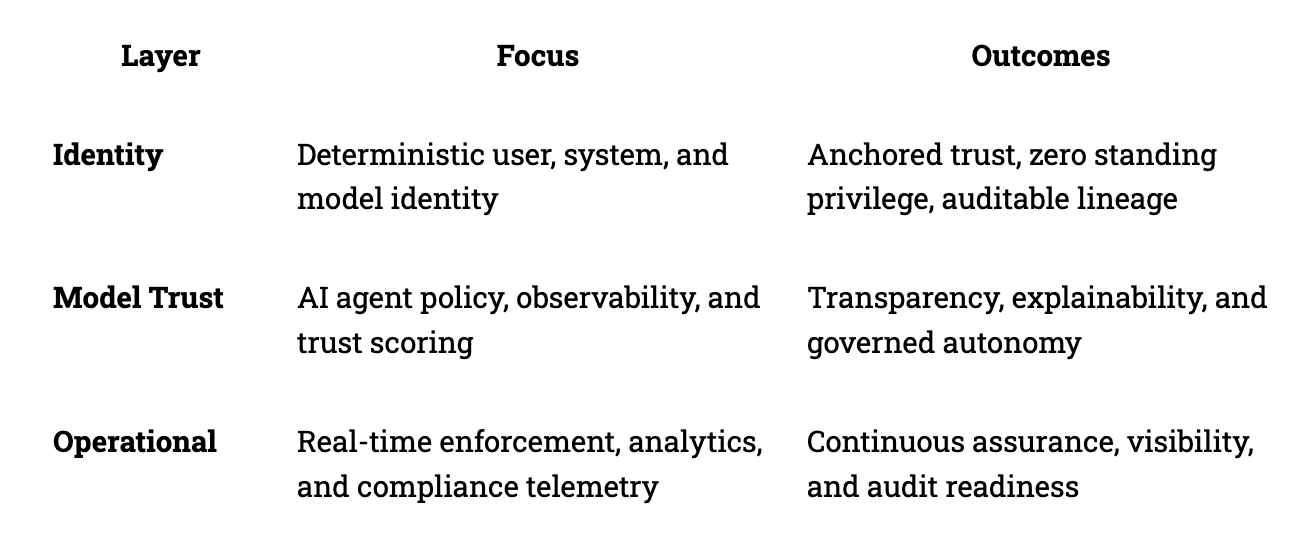
AMTF AI Trust Layers
Use Cases
1. AI Identity Lineage
Bind AI agents and models to enterprise identity systems (inside the AI workloads or externally through legacy IAM).
Enforce least-privilege, just-in-time trust boundaries.
Automate trust certification and recertification across AI workflows, identity lineage, and provenance.
2. Regulatory Compliance and Assurance
Map AMTF telemetry and system scans (e.g., Amazon Bedrok, GCP Vertex) to NIST AI RMF, EU AI Act, SOC 2, and ISO standards.
Automate AI evidence collection (such as configuration and log telemetry) and continuous control validation.
Deliver full explainability in AI-driven decisions and data access.
3. AI Security and Threat Detection
Detect model impersonation, privilege abuse, and shadow access.
Integrate trust telemetry with SIEM/SOAR pipelines for proactive defense.
Enable identity-linked anomaly detection for AI agents.
4. Agentic AI Trust
Monitor AI-to-AI interactions by enforcing trust policies to ensure secure interactions.
Maintain chain-of-reasoning visibility and human override pathways.
Build a resilient ecosystem of interdependent, trusted AI agents.
The Sophos Advisor Advantage
Sophos Advisor’s AI Trust Advisory Service helps organizations assess current AI platforms (e.g., AWS Bedrock, GCP Vertex, Azure OpenAI in Foundry) security risks, map to AI compliance frameworks (e.g., NIST AI RMF, ISO 42001), and design, implement, and operationalize the AI Model Trust framework to unify IAM, AI governance, and compliance.
Our Approach
Assess: Assess and analyze AI platforms (e.g., AWS Bedrock, GCP Vertex, Azure OpenAI Founder) to identify security vulnerabilities, AI trust gaps, and baseline maturity of existing AI governance and compliance programs.
Architect: Design a modular AMTF architecture aligned with enterprise goals and compliance frameworks.
Automate: Implement modern platforms for AI trust, observability, and policy automation within AI workloads, delivering the highest levels of automation for establishing trust, agent lineage, evidence collection, and integration into AI governance, risk, and compliance platforms.
Advance: Enable continuous improvement through metrics, reporting, and executive governance alignment.
Outcomes
Automated AMTF components, lifecycles, and controls.
Alignment with NIST AI RMF and ISO 42001.
Fewer manual governance and compliance tasks.
Faster AI adoption with measurable ROI.
Strengthened compliance posture and reduced audit effort.
Unified trust architecture bridging IAM and AI systems.
Why Leaders Choose Sophos Advisor
Trusted Expertise: Led by two decades at the intersection of IAM, security, and enterprise transformation.
Trust-Centric Philosophy: Every engagement rooted in integrity, transparency, trust, and stewardship.
Future-Ready Framework: Prepare Your Organization for Scalable AI Governance and Compliance.
Measurable ROI: Accelerate AI adoption while maintaining governance clarity and compliance assurance.
The Future of Trust in AI
As enterprises enter the era of agentic AI, trust becomes the new control layer. The AI Model Trust Framework (AMTF) provides the architecture to operationalize that trust — connecting governance, identity, and transparency into a single, measurable system of assurance.
Lead with Wisdom. Deliver with Confidence.